The Age of the Go-To-Market Founder made the case for the operator who spent years inside an industry before building the software it was missing. It opened with the classic VC story: the young technical genius in a dorm room who goes on to change the world. Those founders are worth celebrating, but they’re also rare, and building a whole strategy around them ignores a much larger group of people who have been quietly winning.
“Price is what you pay. Value is what you get.” -Warren Buffett
That post was about who we back. This one is about what we pay, and why the two are more connected than most of the venture industry wants to admit.
In 2017, when we had $12M AUM with around 60 investments, our Managing Partner Victor Gutwein wrote a four-part series called Smaller, Earlier VCs Should Invest Differently. The premise was that the playbook for large, later-stage funds doesn’t transfer to micro-VCs, and that copying it is a bit like watching Steph Curry drive through three defenders and then trying the same move at open gym. The final post in the series, Value Valuations, argued that early investors should be the exact opposite of valuation insensitive.
The industry did not read those posts and change course. Four Medium posts from a small fund in Chicago weren’t going to move markets, and the market went hard in the other direction. The upside is that the math behind the argument is even stronger now than it was then.
This isn’t a hit piece on the mega funds. They’re playing a different game with different math, and for their size it’s a rational one. We just aren’t playing their game.
It’s hard to overstate how concentrated venture capital has become. Andreessen Horowitz raised more than $15B in January 2026, which the firm said was over 18% of all US venture dollars in 2025. Through Q3 2026 it has closed $23.8B, more than 20% of everything US venture funds have raised according to PitchBook. It isn’t just one firm either. In 2024, 30 firms raised 75% of all US venture fund capital and nine firms took half of it. In Q1 2026, 52.8% of new fund dollars went to seven funds from just two firms.
Kyle Harrison made a version of this point recently in The McDonaldization of Venture Capital: venture has split into separate industries that happen to share a name. We told our LPs something similar in our 2026 annual management memo. The venture market isn’t broken, but it is splitting into two very different models.
To be fair to the mega funds, their logic holds up for them. A fund that needs to return billions of dollars needs $100B outcomes, and at that scale it matters far less whether it entered at a $1B or an $8B valuation than whether the company becomes enormous. Magnitude dominates price. As Harrison points out, an LP writing a $250M check into one of these funds is perfectly happy with 2-3x. Nobody on that side of the table is being irrational.
The problem starts when smaller, earlier funds try to play the same game.
Post-YC preseed/seed rounds are the clearest example of the high-price entry point, and it’s the same world the dorm-room founder from the GTM post usually comes out of. A SAFE now starts at $25M post-money, and $30M, $40M and $50M posts are common. $100M isn’t unheard of. A pre-seed fund writing a $1M to $3M check at those prices ends up owning a few percent of the company.
From there, the next round has to be led by one of a few dozen multi-stage platform funds with billions under management. Those rounds are $50M, $100M, sometimes $500M and occasionally more. The revenue underneath those valuations is often thin and new. Sometimes it costs more in compute than it brings in, sometimes it churns quickly and sometimes the “ARR” is committed or contracted in ways that get pretty squishy on closer inspection. The platform fund needs to deploy a lot of capital and own a big piece of the company, which works for them. For the pre-seed investor it means dilution it can’t defend: pro rata on a $100M round isn’t a real option for a $50M fund, and when allocation gets tight, the small fund is usually the first one asked to waive.
This would have been hard to imagine in 2017. The Series A examples in Value Valuations were priced at $14M to $20M pre-money, the range where the series argued a couple million dollars of price didn’t matter much. Today’s post-YC SAFE starts above that range. Pre-seed funds are paying Series A prices (or well beyond those prices) without getting any of the Series A de-risking.
Aileen Lee coined the term “unicorn” in a 2013 TechCrunch post, when only 39 companies qualified. The whole point of the name was rarity. A $1B outcome was dramatic and uncommon, and for most early investors it returned the fund, often several times over. That was the math behind the early-stage funds of 2010 to 2012, which turned out to be some of the best vintages venture has ever had.
Now run that math for a $100M pre-seed fund entering at $50M post. Say it writes a $2M check for 4% and sits through three platform-fund rounds that dilute it by 25%, 22.5% and 20%. By exit it owns 1.86% of the company.
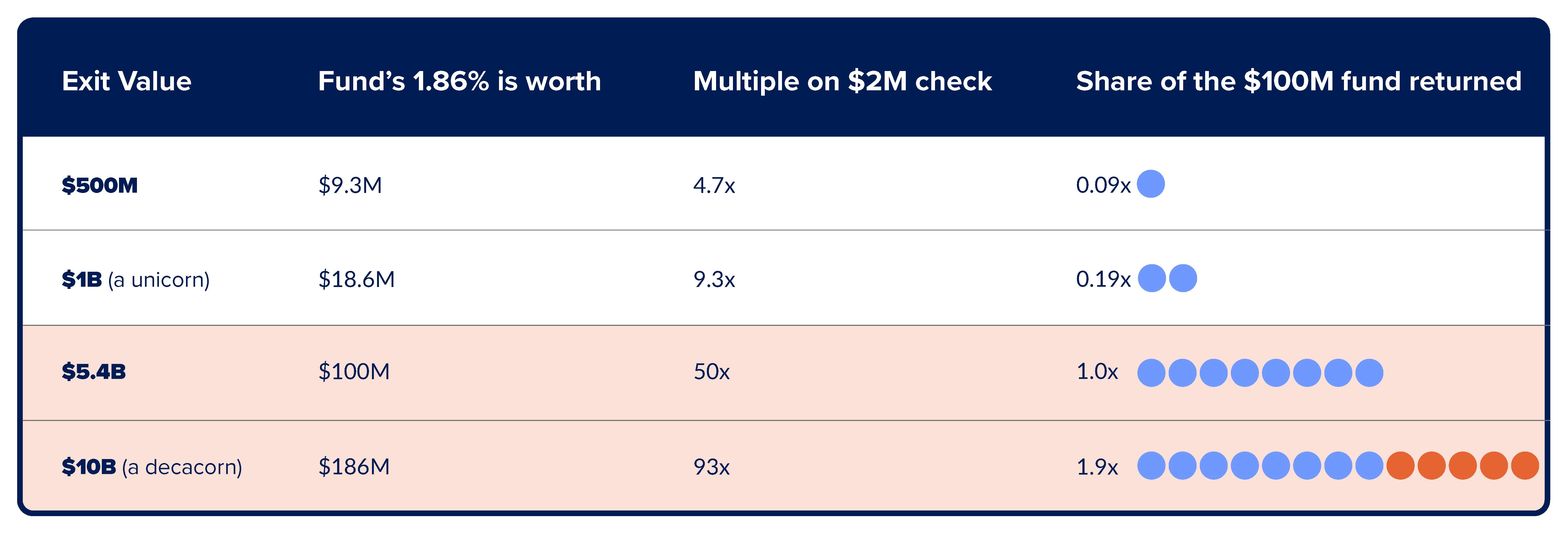
A $1B exit is a lovely 9.3x on the check and less than a fifth of the fund. Even with no dilution at all, it would return $40M, less than half the fund. Entry price does most of the damage. Dilution just makes it worse. To return the fund, the company needs to exit for more than $5B, and realistically $10B, $50B or $100B, because the dilution keeps coming. For a fund playing this game, the decacorn is the new unicorn.
That means every investment in the portfolio has to be a plausible Slack or LinkedIn, and to really move the fund, a SpaceX or Anthropic. There are very few of those companies and very few moments in history when exits that size have actually happened. With 20 or so bets in a fund, the odds of hitting one are low. For that fund, a unicorn is a nice markup.
Part 3 of the 2017 series offers a useful comparison. On a roughly $500M exit after six up-rounds, a seed investor in that model kept about a third of its original stake and still returned nearly 40x. Enter the same company at $50M post today and that $500M exit is closer to 5x.
Our median entry point over recent vintages is $5.5M post-money, a number that sounds almost made up in 2026. Here’s what it does for a $50M fund investing the way we do.
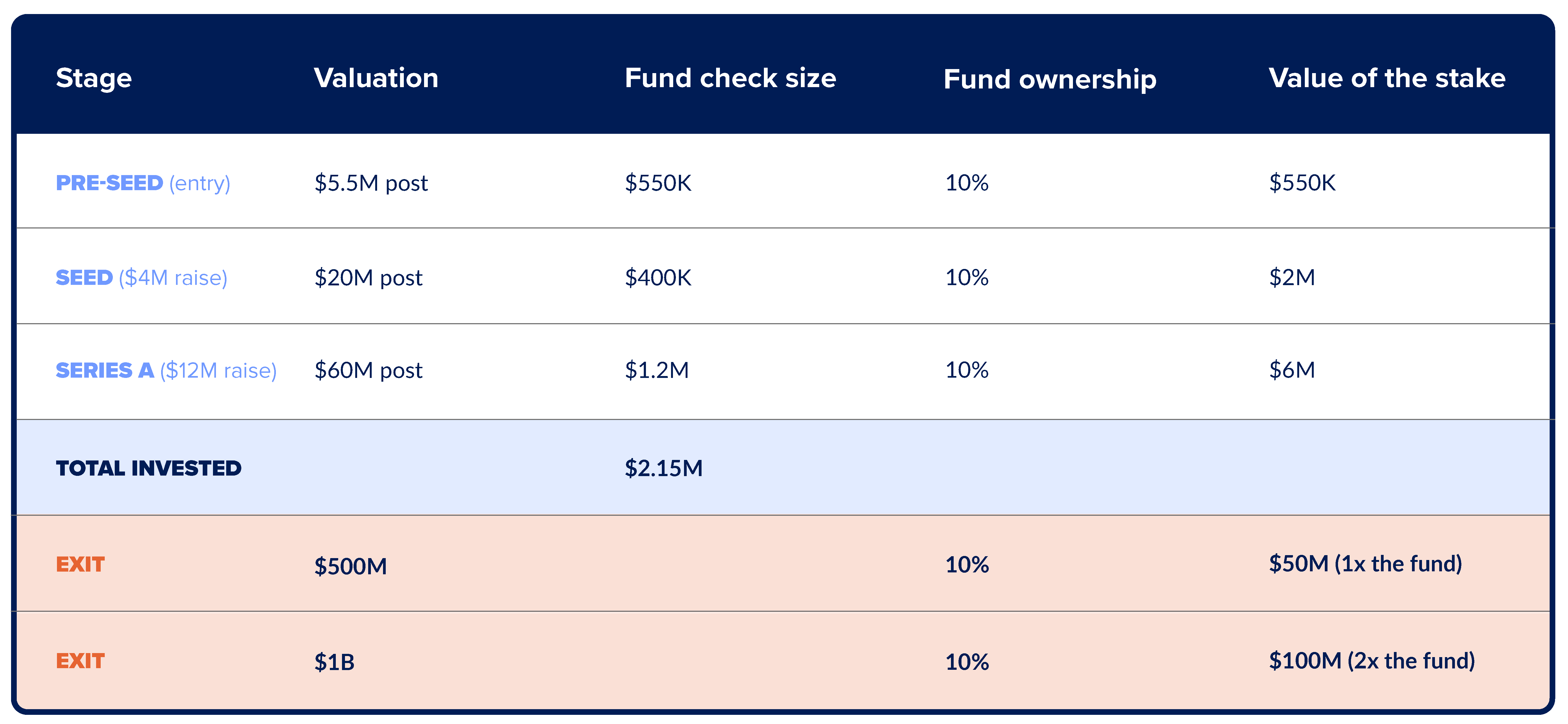
The fund buys 10% at $5.5M. The company raises a $4M seed at $20M post and a $12M Series A at $60M post, and the fund takes its pro rata in both for $2.15M total, about 4% of the fund. The company stops raising, keeps growing and exits for $500M. That 10% returns $50M, the entire fund. For funds like ours that’s the base case rather than the stretch goal, and most of our companies have more potential than that. Several have already reached $1B or more in value.
At $1B, the math is the same math those early 2010s funds ran. A $1B exit returns $100M, or 2x the fund. For us, a unicorn is still a unicorn.
Put the two models side by side on the same $1B exit. The $5.5M entry returns 2x a $50M fund while the post-YC-style path returns less than 20% of its fund. It’s the same company and the same outcome, with roughly a 10x difference in how well each investor does.
Disciplined prices also mean we don’t have to choose between ownership and diversification. We hold about 35 positions per fund, roughly double a typical pre-seed fund, while still owning meaningful stakes in each one.
This is where the two posts meet. The GTM founder is the reason the $5.5M model isn’t wishful thinking.
The GTM post noted that it’s not unusual for a GTM founder to raise a first $1M round with 10-20 customers and $100K to $300K of ARR already live. In Fund IV, GTM founders raised an average first round of $1.25M with about $21K of monthly recurring revenue at the time of our investment. When David Peters started Supercrew after twenty years running a construction company, he didn’t need $5-10M at a $50M post to figure out what to build because he already knew. Founders like that don’t need to raise huge rounds out of the gate, so they never get pulled into the high-valuation, high-dilution game in the first place.
That’s also why some of our companies end up doing something some in the industry have started calling seed-strapping. They raise a couple of rounds, then stop raising and become profitable while still growing. Some are still growing 300% year over year. Others are more mature, in the $20M to $40M ARR range, growing 30% to 50% a year with around 20% EBITDA margins, which makes for a very pleasant Rule of 40 conversation. For us that means no further dilution and ultimately exits in the hundreds of millions to $1B and beyond, all of which are fund returners or better for funds like ours.
The moat the GTM post described, knowing the customer better than anyone because you used to be that customer, turns out to be a capital efficiency story too. Trust and referrals are cheaper than ad spend, and the companies built on them need less money to get big.
The most common pushback, from some LPs and plenty of coastal VCs, goes like this: backing GTM founders at low valuations limits upside. Smaller rounds, smaller markets, smaller outcomes.
The reverse is closer to the truth. A fund that buys in after YC at $25M to $50M post and depends on mega-stage capital for every round after doesn’t see its upside start at $500M. It starts at $5B, because anything smaller barely returns the fund. And to drive the kind of multiples that make venture worth it for LPs, that fund needs $50B or more. That’s a narrow window that requires ‘top of the market’ exit timing in the rarest part of the distribution.
At $5.5M post, our upside starts at $500M and every $1B+ outcome drives multiples of the fund. $1B is 2x. $5B can be up to 10x if the company stays capital efficient. There’s also far more demand for outcomes in this range: plenty of strategics, PE firms and growth investors can buy a $500M or $1B company, and very few can buy a $50B one. And if one of our founders builds a $50B company, we’re on that cap table too. Low entry prices don’t cap anything. They just mean the fund doesn’t need a miracle to be a great one.
This part is for founders. Taking money from a fund the size of Andreessen Horowitz means $100B or bust. There’s no path to a $500M exit that makes a founder’s family wealthy forever, and even a $5B exit doesn’t do much for a fund that size. The economics require founders to burn the ships and swing for the largest possible outcome. That money limits options, and founders should go in with their eyes open.
This isn’t a new worry. Value Valuations warned that high early prices create misalignment, with investors dismissing reasonable acquisition offers to chase a much bigger exit even when that isn’t what’s best for the company. The stakes are just much higher now.
Because we enter at this price, we can be genuinely happy for a founder at $500M, $1B, $5B, $25B or $100B. A founder who wants to build a durable, capital-efficient business and sell it for a life-changing number has us cheering. We don’t need every company to become generational for the fund to work.
The brand signal of a top multi-stage fund also appears to be eroding, a lot like the signal of an elite college degree. It still opens doors in Silicon Valley, but it carries little weight with a contractor in Ohio or a freight broker in Indiana, and those are the customers GTM founders sell to. In some of those industries it can even count against a company, because it reads as elitist investors and technologists who don’t understand how the business works. Founders building for those customers may increasingly prefer capital that’s aligned with more than one outcome.
Underneath all of this is a shift in which markets are big enough to matter. For years a lot of vertical software sold for something like $200 a month, and the addressable market in most niche industries was simply too small for venture capital to care about.
AI changed that. Products in those same verticals can now charge $1,000, $2,000 or $5,000 a month per seat, per office or per location because they replace manual work or directly increase revenue. A hesitant $1K-a-year software buyer becomes a willing $25K or $100K buyer when the ROI is clear. Serviceable markets in niche verticals have exploded compared to five or ten years ago.
Those are the same industries the GTM post highlighted: manufacturing, insurance, supply chain and infrastructure, the backbone of the American economy, which mostly lives in places like Bloomington, Grand Rapids and Columbus rather than on the coasts. Many of those markets are defensibly $1B+ and still too small to move the needle for a $25B to $50B fund. That opportunity set is structurally hard for the largest funds to reach.
Founders who don’t need a $100B outcome have a different route available: pre-seed from a fund like ours, a seed round from a $75M to $250M fund and maybe one more round from a $100M to $500M Series A fund like Run Ventures, which leads Series A rounds outside the coastal hubs and has backed Continuum, Authenticx and PactSafe alongside us. None of those funds need a $50B exit to return their capital.
If mega funds only want $100B outcomes, someone has to fund the companies that grow fast and become very large without ever needing a trillion-dollar story. We expect a category of firms we call “venture growth” to increasingly fill that gap. These firms will pay 8x to 15x revenue for companies at $1M to $5M of ARR growing 2x to 4x a year, and they don’t need a $2B+ exit to have a great fund.
Firms in that group include Telescope, Elephant, Waldo, Avenue Growth, Reformation, Arthur Ventures and Blueprint Equity. Companies in these portfolios may turn out to be very large, bought at sensible multiples rather than hypergrowth multiples and can share excellent alignment with high-achieving GTM founders that don’t want to only shoot for a $100B+ outcome.
It’s a fair question. Why accept a $5.5M post when a founder could, in theory, get $50M?
Part of the answer is structural. There has been a real culling of the venture market since 2021. First-time funds fell from 479 in 2022 to 195 in 2025 to just 81 so far in 2026, per PitchBook. Fewer small funds means much less competition for these deals, and founders in many markets have fewer options than the conventional narrative suggests.
Part of it is attitude. On recent trips to the coasts, we’ve heard from fewer and fewer firms that are excited about backing post-YC companies at $25M to $50M post, and there’s real fatigue with that game. And as the GTM post laid out, many GTM founders simply aren’t on that path. They don’t need $5M on day one, so they aren’t shopping for it.
Part of it is timing. We’ve historically been willing to write the first check earlier than most of our seed-focused peers, including plenty that call themselves pre-seed. Building conviction in a founder before the metrics make it obvious is the job, and we’ve been doing it for more than a decade. Founders get capital when it’s hardest to find, and a partner who helps them get further on less, so they reach the next round with more to show for it.
There’s also a quieter benefit that the 2017 series made and that still holds. A fair early price makes the next round easier to raise, while an inflated one means a company needs exceptional growth just to avoid a flat or down round.
The mega funds will keep winning the headlines, and some of them will produce great returns. Funds like ours will keep doing something less flashy: buying meaningful ownership at disciplined prices in founders who already have customers, then letting a $500M or $1B outcome do exactly what it did for the best funds of the early 2010s.
The GTM post argued that for most startups, the moat has become experience. For venture funds, the moat may be price. As we wrote in our memo, the cost of building software may be dropping drastically, but the cost of building trust is not. The price paid still matters. It mattered in 2017, and it matters more now.
About M25: M25 is an early-stage software-focused venture firm based in Chicago, investing solely in tech startups headquartered in the Midwest. Since launching in 2015, M25 has become the most active investor in the region, quickly becoming the preferred seed investor for the next generation of Midwest unicorns. Portfolio companies include Kin Insurance, Loop Returns, Astronomer, Branch Pay, Authenticx, Redi Health, Continuum AI and more.